

A deployment pipeline reports a successful scan. An analyst receives a confident AI summary. A recovery console says a restore completed. Each result looks like an answer.
But an answer to what?
A scan may describe a different build from the one being deployed. A summary may have been influenced by instructions hidden inside malware. A restored system may be available without being ready to support trustworthy business operations.
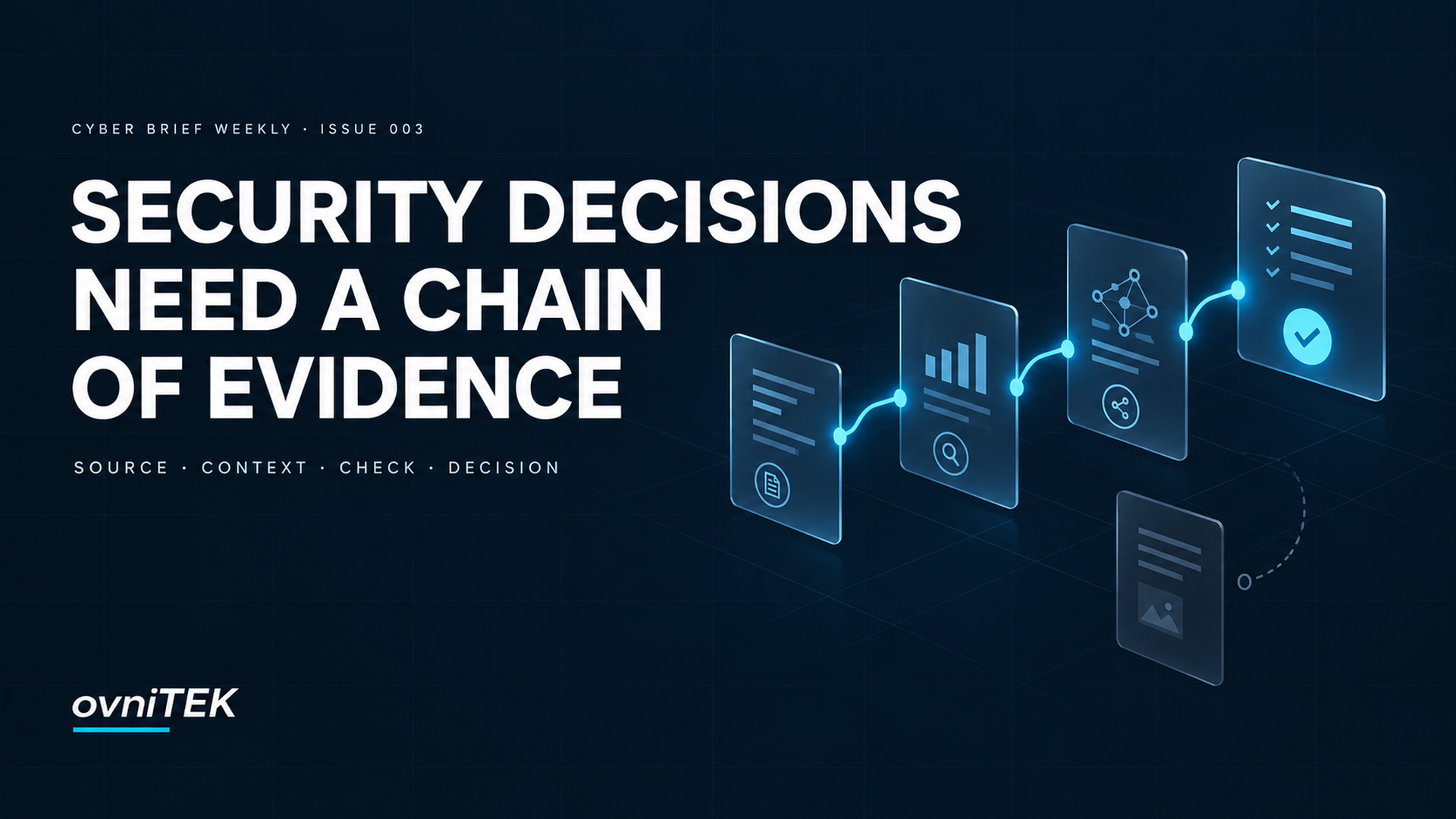
Across Cyber Briefs #025–#030, the recurring problem is not simply missing information. It is losing the connection between information and the decision it is supposed to support.
The practical question is: can you trace a consequential security decision back through its source, context, checks, and accountable owner?
Start with the business decision—not the dashboard
For a small business, the important decision might be whether staff can safely resume processing payments. For a software team, it might be whether a build can enter production. For an incident lead, it might be whether containment can be relaxed.
Those decisions need different evidence. Collecting more logs or adding another scanner is not automatically the answer.
The UK NCSC’s October 1 guidance on identifying critical systems highlights privileged accounts, identity infrastructure, backups, and systems supporting essential functions. Our interpretation: evidence should be organized around the services whose failure would matter most, not only around the tools that produce it.
If customer invoicing depends on cloud identity, an accounting application, and a supplier connection, an “all servers healthy” dashboard cannot establish that invoicing is ready. The service owner needs evidence about the actual workflow and its dependencies.
This is how asset knowledge becomes a decision rather than a list.
Keep the evidence attached to the thing being approved
The NIST NCCoE’s September 24 DevSecOps update adds a second example implementation and lifecycle scenarios. Its implementation documentation describes testing, security scans, artifact attestations, and policy enforcement. This is a demonstration, with the updated sections open for comment through November 9—not a mandatory architecture or product endorsement.
The operational lesson is broader than the example: a favorable report should not authorize an unrelated artifact.
A release decision should identify the artifact, the checks performed on it, the applicable policy, and any approved exception. If a build changes after testing, the earlier report needs to be reconsidered. If an alternate deployment route bypasses the gate, the evidence never controlled the outcome.
The same principle applies outside software development. A supplier’s general assurance statement does not prove that your specific service configuration is covered. A backup test from last quarter does not prove that tomorrow’s recovery dependencies are unchanged.
Ask what the evidence actually attaches to—and whether that is still the object being approved.
Do not let hostile content become authority
Evidence can also be deliberately misleading.
On October 8, Cisco Talos described a phishing campaign observed in mid-2026 against people affiliated with Taiwan research organizations. Legitimate event themes and altered QR codes helped disguise destinations; a Google-lookalike authentication relay intercepted credentials and MFA challenges.
The relevant lesson is not that every invitation is malicious. It is that plausible content does not establish the safety of the activity it initiates. Email, destination, authentication, device, and session observations need to be considered together.
In separate October 8 research, Talos examined malware containing instructions aimed at AI-assisted analysis. Test results varied, so the findings should not be presented as universal bypass of AI security tools. They do demonstrate an adversarial boundary: text taken from a suspicious sample is material to analyze, not authority to direct the investigation.
Our recommendation is to preserve the original artifacts and compare automated conclusions with behavioral evidence. Two summaries based on the same extraction are not necessarily independent corroboration.
A polished explanation cannot substitute for a traceable finding.
Ownership must survive the handoff
Evidence crosses boundaries: provider to customer, developer to operator, analyst to incident lead, recovery team to service owner.
NIST’s September 15 announcement of finalized token-protection guidance describes responsibilities for both cloud providers and their customers. Its primary audience is federal agencies and their providers, although the guidance can inform other organizations.
For any shared service, make the handoff concrete. Who supplies the relevant records? Who can revoke access? Who decides that the evidence is sufficient? What happens if the provider cannot supply it during an incident?
A responsibility map is useful only if it identifies usable capabilities and reachable people. “The supplier handles security” is not an operational answer.
The decision owner may delegate technical checks. They still need to understand the limits of those checks before approving the next action.
Recovery is an evidence decision too
The NCSC’s technical recovery preparation guidance, published October 1, addresses tested backups, dependencies, data reconciliation, and security validation before reconnecting cloud systems.
A completed restore is therefore one input to approval, not the entire approval.
A practical recovery review should ask whether the restored state is appropriate, required dependencies work, unresolved compromise has been addressed, and business transactions produce the expected result. Records created during temporary operations also need consideration before normal processing resumes.
NIST CSF 2.0 distinguishes verification of restoration assets before use (RC.RP-03) from verification of restored assets and confirmation of normal operating status (RC.RP-05). It also calls for preserving incident-data integrity and provenance (RS.AN-07) and correlating information from multiple sources (DE.AE-03).
These outcomes support the argument. They are not a certification that a particular decision is correct.
A small decision record you can use this week
Choose one consequential decision and write down five things:
- Decision and owner: What action is being approved, by whom, and for which service?
- Source and scope: Which artifacts, systems, identities, records, and time period does the evidence cover?
- Context and checks: What was compared, tested, or independently corroborated?
- Limits and exceptions: What remains unknown, and who can accept the residual risk?
- Action and review trigger: What is allowed now, and what change would require reassessment?
For example, do not record only “restore successful.” Record the recovery point, checks performed, transaction result, unresolved limitations, service-owner approval, and conditions for reconnecting.
This is an ovniTEK working model, not a prescribed NIST form. Keep it proportionate: one useful page is better than an elaborate record nobody can produce under pressure.
The goal is not perfect certainty. It is to prevent an unexamined signal from silently becoming permission to act.
Which important decision in your organization currently depends on evidence nobody can trace?
Sources and further reading
NIST CSF 2.0 · NIST token-protection guidance · NCCoE DevSecOps update · NCSC critical-system guidance · NCSC technical recovery guidance · Talos phishing research · Talos AI-analysis evasion research
Cyber Brief Weekly is an independent ovniTEK publication. NIST CSF 2.0 references provide educational alignment, not NIST endorsement, certification, or a guarantee of security.