

A policy exists. Multifactor authentication is enabled. Logs are being collected. The backup job is green. The vulnerability is patched.
Each statement sounds reassuring. None of them, by itself, proves that the organization has achieved the security outcome it intended.
That distinction runs through the first fourteen editions of Cyber Brief. A policy nobody can find is not an effective control. MFA that leaves privileged accounts on phishable methods is not the finish line. A dashboard cannot detect activity from systems that never send telemetry. A successful backup does not prove that a business service can be restored safely. A patch closes a vulnerability, but it does not establish that exploitation did not happen before the fix.
The recurring lesson is simple:
A control is not proven by its presence. It is proven by evidence that it covers the right risk, operates as intended, and produces a result the organization can verify.
The framework describes outcomes—not checkboxes
NIST Cybersecurity Framework 2.0 organizes cybersecurity into six Functions: Govern, Identify, Protect, Detect, Respond, and Recover. NIST describes those Functions as concurrent and continuous. It also explicitly says the Core outcomes are not a checklist of actions; implementation varies by organization and use case.
That matters because the same technology can support very different outcomes depending on how it is owned, configured, monitored, tested, and maintained.
NIST’s measurement and assessment guidance makes the distinction even clearer. SP 800-55 Volume 1 addresses measures for evaluating the adequacy of in-place security policies, procedures, and controls. SP 800-53A Revision 5 provides customizable assessment procedures for determining whether security and privacy controls are implemented and supporting intended risk-management outcomes.
The practical message is not that every small organization needs a federal-style assessment program. It is that “we have it” and “it works” are different claims—and they require different evidence.
Four questions turn a control into a defensible decision
1. Who owns the outcome?
Every control needs an accountable owner with enough authority to make the relevant decision.
For a policy, that means an approver and an enforcement owner. For an incident plan, it means knowing who can isolate a system, suspend an account, contact a supplier, or brief leadership. For an AI agent, it means a named business owner, technical owner, approved purpose, and a person who can revoke its authority.
“Security owns it” is usually incomplete. Security may advise, monitor, or challenge a decision, while a business or system owner remains accountable for the service and its risk.
Evidence might include an approval record, responsibility matrix, escalation path, service owner, exception decision, or exercise record.
2. What does the control actually cover?
A control cannot protect an asset, identity, dependency, or data flow that remains outside its scope.
This is why inventories are not administrative housekeeping. An organization needs to reconcile what it believes it manages with what is actually exposed: endpoints, cloud resources, SaaS, internet-facing services, privileged identities, vendors, software versions, and agent permissions.
The same question applies to detection. A SIEM can be functioning correctly while a critical cloud audit source, endpoint, or identity system sends no usable telemetry. A green dashboard may demonstrate platform availability—not detection coverage.
Evidence might include asset and identity inventories, external discovery results, version data, data-flow diagrams, telemetry maps, vendor tiers, or documented exclusions.
3. Is it operating when the risk becomes real?
Configuration is a point-in-time statement. Operation is observable behavior.
MFA may be enabled, but the method and recovery path determine whether a privileged account can still be phished. A response workflow may be documented, but the real question is how quickly it produces a scoped, authorized action under pressure.
Microsoft’s QNET case study offers a useful example. Microsoft reports that Defender isolated a compromised endpoint 128 seconds after the first high-severity alert. The important evidence was not only speed: the action was scoped to the device, retained necessary security-service access, created an audit trail, and included an auto-release mechanism. Microsoft reported no observed second-stage payload, outbound command-and-control traffic, or lateral movement after isolation.
That is what an operational control looks like: a trigger, a decision, a bounded action, a record, and a result.
Evidence might include authentication events, alert timestamps, automated-action logs, analyst handoffs, release conditions, exercise results, or exception records.
4. How do we know the result is safe and complete?
The final proof is validation.
Cisco’s September advisory for an actively exploited Secure Email Gateway vulnerability illustrates why remediation and verification are separate activities. Cisco released fixed software and reported that no workaround addressed the vulnerability. It also warned that root-level access could allow attackers to hide or remove evidence, so administrators should review appliance logs and cross-check external network and firewall logs.
Installing the fixed release reduces future exposure. It does not answer whether the appliance was compromised before the upgrade.
Recovery has the same structure. In its September 18 incident update, Luminis Health reported that telephone service had been restored across its locations while other affected systems remained under restoration. The organization said systems were being tested for safety and quality as they returned. A service being online was one milestone; confirming that it was ready was another.
Evidence might include compromise assessments, external logs, restore tests, integrity checks, owner acceptance, service tests, recovery targets, and exit criteria.
Evidence has an expiration date
Even strong evidence can become stale when the environment changes.
Google’s September 18 description of its agentic infrastructure-security pipeline makes that problem concrete. Google says its localized threat models use live codebase metadata and dependency call graphs rather than static, separate documents. The company reports that current context reduced false-positive rates to 3% in some cases, while a specialized triage step checks whether a vulnerable code path is actually reachable.
The broader lesson applies beyond software development: every meaningful change can invalidate yesterday’s assurance. A new dependency, permission, supplier, data flow, exception, or business requirement can change the risk without changing the document intended to describe it.
Controls therefore need review triggers, not only annual review dates.
A practical evidence review for this week
Choose one control your organization currently describes as “implemented.” Then ask:
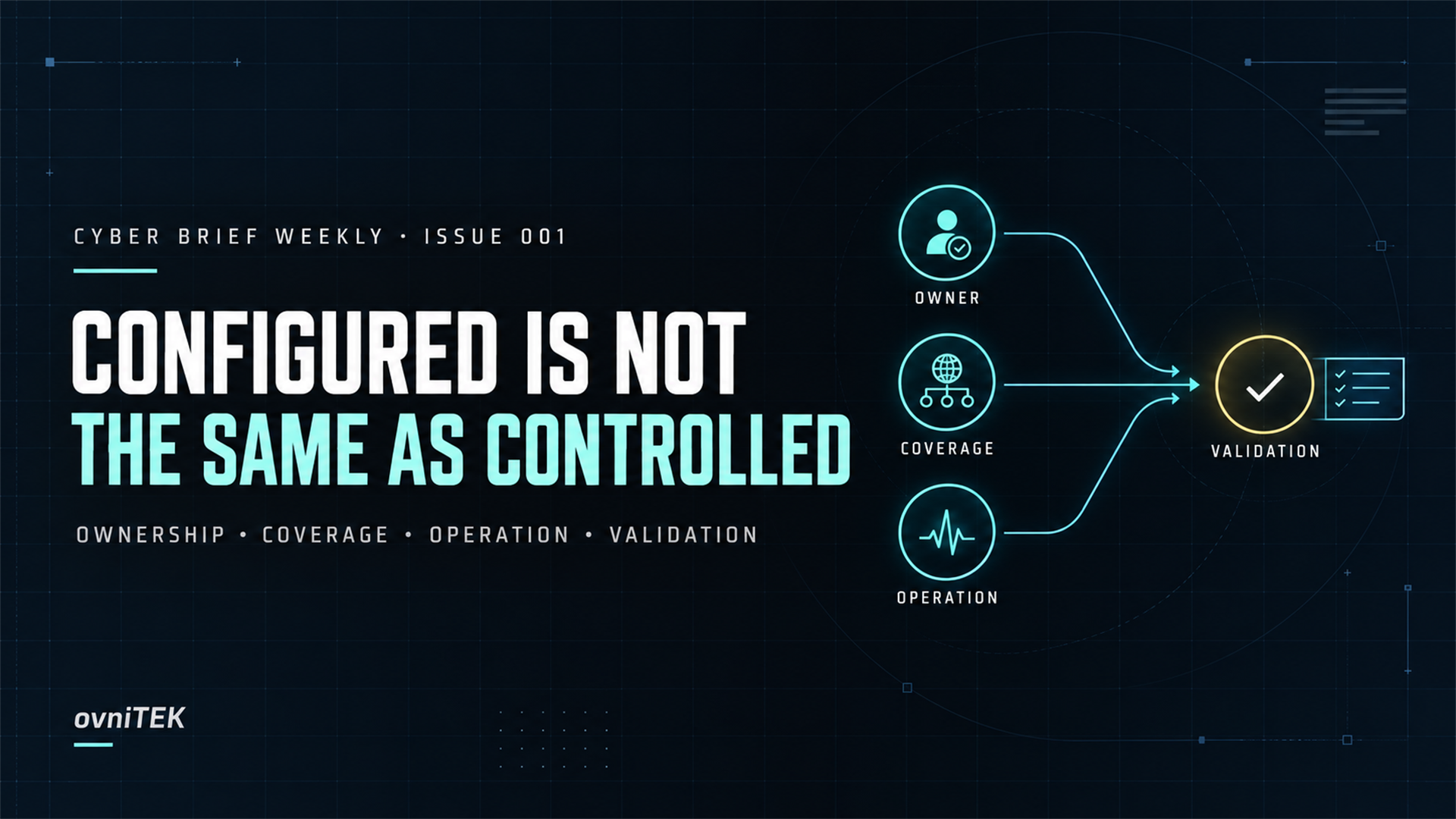
- Owner: Who is accountable for the outcome and authorized to act?
- Coverage: Which assets, identities, services, and dependencies are included—and which are excluded?
- Operation: What recent record shows that the control performed its intended function?
- Validation: What test or independent evidence shows that the result was effective and complete?
- Freshness: What change would require the evidence and risk decision to be revisited?
If the answers rely on assumption, memory, or a configuration screenshot with no operational context, the organization has found an assurance gap.
That gap does not automatically mean the control has failed. It means the organization cannot yet make a defensible claim about the outcome.
The decision to carry forward
Cybersecurity maturity is not the number of tools deployed or documents approved. It is the organization’s ability to connect risk to an owner, a control to its actual scope, an action to an observable record, and a claimed outcome to current evidence.
Configured is not the same as controlled.
The difference is proof.
Sources and further reading
- NIST Cybersecurity Framework 2.0
- NIST SP 800-55 Volume 1 — Identifying and Selecting Measures
- NIST SP 800-53A Revision 5 — Assessing Security and Privacy Controls
- Cisco Secure Email Gateway Security Advisory
- Microsoft Security Research — QNET device-isolation case study
- Luminis Health Cybersecurity Incident Update
- Google Cloud — Using agentic AI to secure infrastructure code
Cyber Brief Weekly explains the cybersecurity changes that matter, the decisions they affect, and the evidence organizations should review next. Cyber Brief is an independent ovniTEK publication aligned to NIST CSF 2.0; it is not an official NIST assessment, certification, or endorsement.